
November 5, 2026
Why Proper Vacuuming Matters During Aircon Installation in Singapore
Vacuuming removes air and moisture from your aircon’s refrigerant pipes before refrigerant is released. Skipping it can mean weak cooling, higher bills and early compressor failure. Here is why it matters for aircon installation in Singapore and how to check your installer did it right.
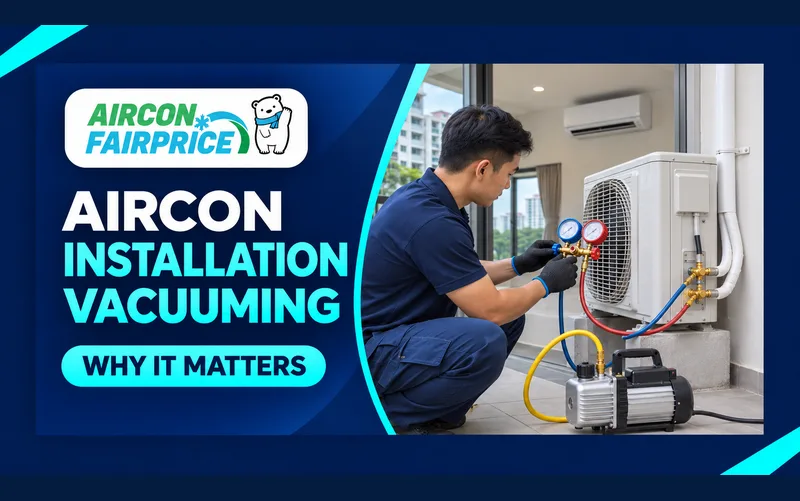
Quick answer: Vacuuming removes air and moisture from your aircon's refrigerant pipes before refrigerant is released. Skipping it or rushing it can cause weak cooling, higher electricity bills and early compressor failure. For any aircon installation Singapore homeowners book, proper vacuuming is one of the most important steps, and one of the least visible.
Most people judge an installation by how neat the piping looks or how quickly the team finishes. But the step that most affects your aircon's lifespan happens out of sight. Here is what it is, why it matters, and how to make sure it is done right.
What Is Vacuuming in Aircon Installation?
Vacuuming, also called evacuation, is the process of using a vacuum pump to pull air, moisture and other non-condensable gases out of the refrigerant pipes and indoor coil. It happens after the indoor and outdoor units are connected and before the refrigerant is released into the system.
A new aircon system is full of ordinary air when it is first connected. That air carries water vapor, especially in a humid climate. Refrigerant circuits are designed to hold only refrigerant and a small amount of oil. Anything else is contamination.
Why Does Vacuuming Matter?
A clean, dry refrigerant circuit protects your investment. When air and moisture remain inside, several problems can follow:
Moisture damage: Water can react with refrigerant and oil to form acids and sludge, which wear down the compressor and clog components.
Reduced cooling: Air takes up space and raises system pressure, so the compressor works harder for less cooling.
Higher energy bills: A struggling compressor draws more power, which adds up when an aircon runs many hours a day.
Shorter lifespan: Contaminants speed up wear. The compressor is the most expensive part of the system.
Blockages and leaks: Moisture can freeze at the expansion device and restrict flow, and poor connections can go unnoticed without a proper hold test.
These problems often appear months later, not on installation day. That is why a poor job can look perfectly fine at handover.
Aircon leaking or not cold? Talk to our technician today
Why Is Vacuuming Especially Important in Singapore?
Singapore's tropical climate makes the step more important, not less.
High humidity: With humidity high year-round and frequent rain, there is more moisture in the air that enters pipes during installation.
Long running hours: Many households run aircons for many hours daily, so even a small efficiency loss shows up on your SP Group bill.
Property layouts: HDB flats, condominiums and landed homes often need long or bent pipe runs, especially for multi-split setups such as System 3 or System 4. More pipe length means more air and moisture to remove.
Energy awareness: Singapore's Mandatory Energy Labelling Scheme rates aircons by efficiency (the more ticks, the better), but even a 5-tick unit will not perform to its rating if the circuit is contaminated.
If you invest in an efficient inverter unit, proper vacuuming helps you actually get that efficiency.
How Is Vacuuming Done Step by Step?
Professional installers generally follow a sequence like this. Exact figures vary by manufacturer, so the unit's installation manual is the final reference.
Connect the piping: Flare and connect the copper pipes between the indoor and outdoor units.
Nitrogen pressure test: Pressurize the lines with nitrogen to check for leaks at the joints.
Connect pump and gauges: Attach a vacuum pump, manifold gauge set and ideally a micron gauge to the service valves.
Pull the vacuum: Run the pump until the system reaches a deep vacuum, commonly around 500 microns or lower, depending on the manufacturer's specification.
Hold test: Close the valves and switch off the pump. If the reading stays stable, the system is dry and leak-free. If it climbs, there is moisture or a leak.
Release refrigerant: Open the service valves so the refrigerant flows in, then test and commission the system.
The time needed depends on pipe length and conditions. A rushed job that finishes in minutes is a warning sign.
Vacuuming vs. Purging: What Is the Difference?
Some installers use purging instead. This means releasing a small amount of the unit's refrigerant to push air out of the lines.
Vacuuming: Removes both air and moisture thoroughly, can be verified with a gauge, and does not release refrigerant.
Purging: Faster and needs less equipment, but cannot remove moisture well, wastes refrigerant, and releases it into the atmosphere.
Purging may be seen as a shortcut. For a long-lasting system, vacuuming with a pump is the better practice.
How Can You Tell If Your Installer Did It Properly?
You do not need technical knowledge.
Ask these questions before and during your aircon installation:
Do you use a vacuum pump and a micron gauge?
Will you do a nitrogen pressure test and a hold test?
Is vacuuming included in the quotation?
Can I see the gauge reading?
Red flags: No vacuum pump on site, an unusually low quote, installation completed far faster than other quotes, or vague answers about testing. A reputable company will explain its process confidently and usually be happy to show it.
Book aircon servicing or repair with expert technicians
Signs of Poor Vacuuming
Problems from an improper job often show up weeks or months later:
Aircon blowing weak or warm air
Ice forming on the indoor coil or pipes
Water leaking from the indoor unit
Unusual noises from the outdoor unit
Electricity bills rising without explanation
Frequent breakdowns or early compressor failure
Correcting these issues can mean re-evacuating the system, repairing leaks or, in the worst case, replacing the compressor. That is typically far costlier than a thorough installation. Some manufacturer warranties may also depend on proper installation, so check your warranty terms.
Choosing an Aircon Installation Service in Singapore
Price matters, but the cheapest quote can hide shortcuts.
When comparing providers for aircon installation Singapore residents rely on, look at:
Process transparency: Clear explanation of vacuuming, testing and commissioning.
System expertise: Experience with System 1 to System 4 and multi-split units, and with different property types.
Local rules: Familiarity with HDB and condominium (MCST) guidelines on outdoor unit placement and drainage. Check with your town council or management office if unsure.
Warranty: A workmanship warranty in addition to the manufacturer's warranty.
Aftersales: Servicing and repair support, so you are not left alone after handover.
Itemized quotation: Piping length, brackets, drainage and labor listed clearly.
A good provider treats vacuuming as a standard step, not an optional extra.
Frequently Asked Questions
Is vacuuming necessary for every aircon installation? Yes, for split-type systems installed with new or extended piping, it is the recommended practice. Skipping it risks moisture and air staying in the system.
How long does vacuuming take? It varies with pipe length and the pump used, but it is not instant. Many installations need roughly 15 to 30 minutes or more, plus time for the hold test.
Can I do aircon installation myself? DIY is not recommended. It needs specialized tools, refrigerant handling and electrical work, and mistakes can void your warranty or damage the unit.
Does poor vacuuming void my warranty? It depends on the manufacturer and installer. Poor installation can lead to claims being rejected, so ask for the warranty terms in writing.
What if my aircon was installed years ago and I am unsure? If your aircon cools well, runs efficiently and has no leaks, it is likely in good condition. If you notice warning signs, an experienced aircon company in Singapore can inspect the system and recommend the right solution.
Final Thoughts
Proper vacuuming is easy to overlook because you cannot see it, yet it protects your cooling performance, your energy bills and your compressor. In Singapore's humid climate, it matters even more. Before you book your next aircon installation Singapore provider, ask how they vacuum, test and verify the system. Choosing a team that does it properly is one of the simplest ways to keep your aircon running well for years.
To discuss your aircon installation in Singapore and get a quote, contact AirconFairPrice.Sg.